
Circadian Rhythm
The Body's Internal Clock and the Morning Signals That Set It
Tobias Ashcroft · 4 March 2026
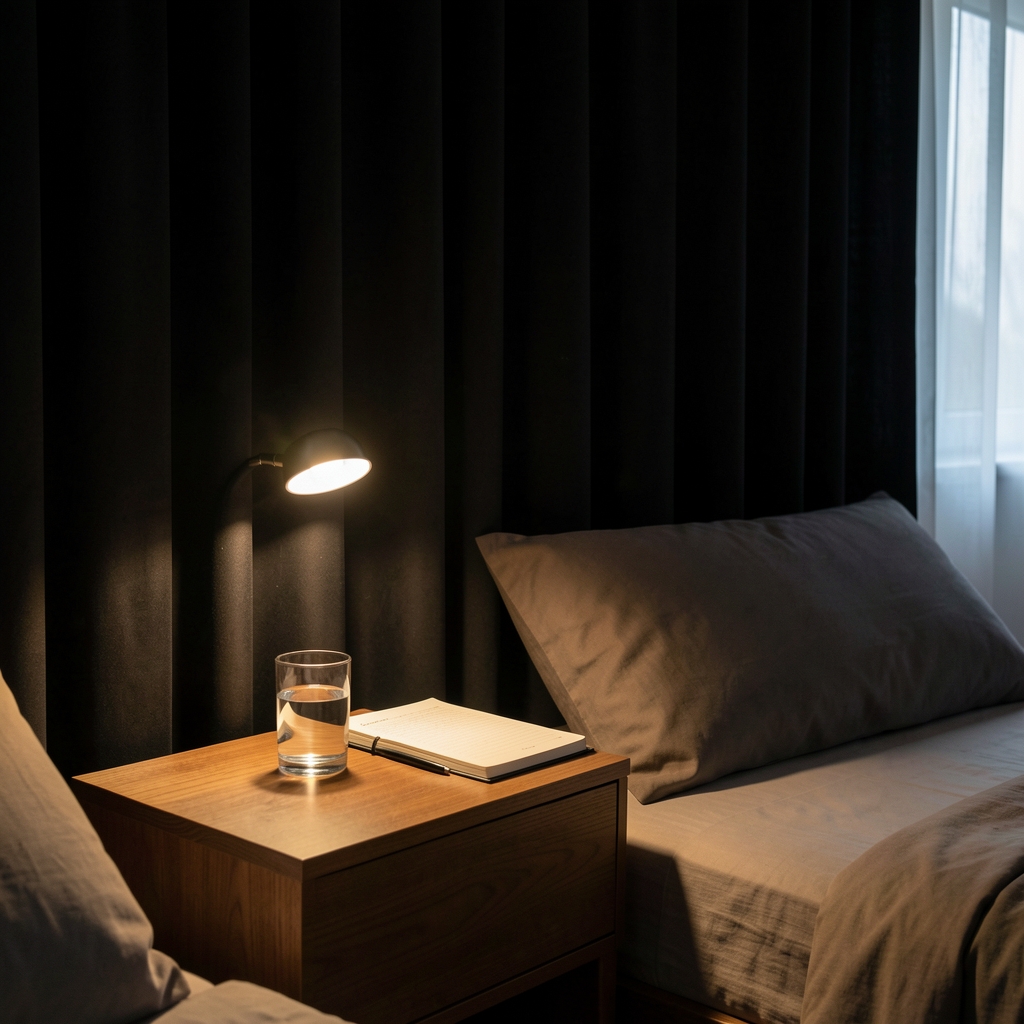
The conditions of the room in which one sleeps bear quietly on the quality of what follows. Temperature, light, sound, and the arrangement of surfaces each contribute a small but observable influence on how easily rest arrives — and how well it persists through the night.
Among all the variables documented in sleep-environment research, room temperature appears consistently as one of the most influential. The body's internal processes involve a natural downward shift in core temperature as the evening progresses — a shift that serves as one of the signals marking the transition toward deeper rest. A room that is too warm can interrupt or delay this process.
The range most commonly cited in the published literature sits between sixteen and nineteen degrees Celsius for the sleeping environment, though individual responses vary considerably. What seems consistent is that the direction of temperature change — downward, from waking temperature — appears more important than any single fixed number. The room's coolness facilitates what the body is already attempting to do.
Practical approaches include keeping windows open during the later evening hours, choosing bedding with lower thermal retention for warmer months, and being attentive to how body temperature changes in different seasons. The sleep environment is not a fixed setting to be established once; it requires attentive adjustment as conditions change across the year.
"The room's conditions do not determine the quality of rest — but they either work with the body's own patterns or quietly against them."
The relationship between light and the body's internal timing system is well-established in the literature on circadian biology. The photoreceptive cells of the eye respond to certain wavelengths — particularly the short-wave, blue-spectrum light that predominates in daylight and in the screens of phones, computers, and televisions — and transmit signals that influence the timing of melatonin-related processes in the evening.
In a sleep environment, the relevant concern is light in the hours before sleep and the conditions of the room during the night itself. Blackout curtains or well-fitted blinds have become a common response to the ambient light of urban environments — the orange glow of streetlights, the intermittent sweep of vehicle headlights, the low persistent light from neighbouring buildings. Each of these, individually minor, can contribute to a sleep environment that the body reads as less fully dark than the conditions that support sustained rest.
The management of light in the sleep environment also includes the devices within the room. Many people's bedrooms contain standby lights on televisions, charging indicators on phones, and alarm displays that emit a persistent low-level illumination. Moving charging stations outside the bedroom and covering indicator lights are among the more frequently noted adjustments in sleep-environment literature.
Sound is a more variable factor than temperature or light, partly because individual responses differ considerably and partly because the problem of sound in urban environments is often less tractable. The general principle is that irregular or unpredictable sounds — traffic, voices, building noise — are more disruptive than consistent background noise, because the auditory system continues to process sound during the lighter stages of the sleep cycle and will attend to changes or anomalies in the acoustic environment.
Some people find that consistent low-level background sound — a fan, a white noise application, the low hum of a ventilation system — reduces the perceptible contrast when intermittent noises occur. This is a reported rather than universal finding, and the most appropriate approach depends on the individual's sensitivity to sound and the specific acoustic conditions of the room.
Heavy curtains and carpeted floors provide incidental acoustic dampening, as do bookshelves and soft furnishings. Rooms that are bare and reflective — polished floors, plaster walls, minimal furniture — tend to allow more sound transmission and reverberation than furnished rooms with soft surfaces. This is rarely considered when arranging a bedroom, but it is worth noting when evaluating why certain rooms feel more or less conducive to rest.
The weighted blanket is among the more recent additions to the sleep-environment literature — or more precisely, it is a traditional object that has attracted more systematic attention in the past decade. The underlying principle involves deep pressure stimulation: the even, distributed weight of a heavier blanket is thought to engage sensory receptors in a way that is associated with a calming effect on the nervous system.
Several small-scale studies have reported positive associations between weighted blankets and self-reported sleep quality in adult populations, with particular attention to the ease of sleep onset and a reduction in the subjective experience of wakefulness during the night. The evidence base is not large, and most researchers in this area note the need for further work with larger samples and more controlled conditions. The weighted blanket is not a response to a deficiency; it is one environmental variable among many that some people find supports their experience of rest.
From a practical standpoint, the weight of the blanket matters: too heavy, and it may cause physical discomfort; the weight range most commonly referenced in the literature — roughly ten per cent of body weight — is a starting point rather than a fixed rule. Temperature tolerance is also relevant: weighted blankets typically have more thermal retention than standard duvets, which may work against the temperature considerations noted earlier.
Beyond temperature, light, and sound, the arrangement and purpose of the room play a less-documented but frequently noted role in how the space is experienced. The sleep environment literature consistently returns to the principle of associative conditioning: the body and mind build associations between spaces and the kinds of activity that occur in them. A room used for work, entertainment, and eating sends a more complex set of signals than one used primarily for rest.
This is not a claim about architectural necessity. Many people do not have the luxury of a bedroom used for rest alone. But the principle suggests that small adjustments — keeping work materials in a different part of the room or covered, using a different lamp or light setting for the bedroom versus other rooms, maintaining a consistent evening routine that begins before entering the bedroom — can make a modest contribution to the associative clarity of the space.
The physical condition of the mattress and pillow is also worth noting, not as an aspirational purchase but as a maintenance question. Mattresses that have changed shape or firmness over years of use may no longer support the posture that the person now requires. This is a gradual change and therefore easy to overlook; it may only become apparent when sleeping somewhere else reveals what had gone unnoticed at home.
The sleep environment is one of the more tractable parts of the sleep-quality picture. Unlike circadian timing, which involves complex interactions with light exposure and daily schedule, the physical conditions of the room are largely within the control of the person sleeping in it. Small, sustained adjustments — addressing each variable in turn, attending to what changes and what does not — tend to yield more reliable results than large overnight overhauls.
A room that encourages rest is not a room decorated for the purpose or furnished expensively. It is a room in which the conditions — temperature, light, sound, arrangement — are kept, as much as possible, in alignment with what the body requires in order to complete the transition from waking to sleep and to remain there through the night.

Eleanor has spent fifteen years writing about the relationship between daily environment and personal wellbeing. She brings a particular interest in the architecture of sleep spaces and the role of consistent evening patterns in supporting longer-term rest quality.
More from Eleanor Whitfield →