Sleep Environment
A Room That Encourages Rest: Notes on the Sleep Environment
Eleanor Whitfield · 10 February 2026

Circadian rhythm describes the body's internal timing system — a roughly twenty-four-hour cycle governing when alertness rises, when appetite patterns shift, when the body's temperature changes, and when the conditions that support deep rest become available. It is not a metaphor. It is a documented physiological system, and its calibration matters practically for those who want to sleep well.
The body's internal timing system is not a single clock but a hierarchy of timing processes. The master regulator sits in the suprachiasmatic nucleus — a small structure in the hypothalamus that receives direct input from the eye's light-sensitive cells. This structure coordinates the timing of processes throughout the body, including the release of alertness-supporting signals in the morning and the conditions that facilitate rest in the evening.
Below this master regulator, peripheral timing systems exist in individual organs and tissues — the liver, the gut, the skin, the muscles — each running on their own version of the twenty-four-hour cycle. These peripheral systems can be influenced independently, which means that eating at unusual times, exercising at night, or being exposed to bright light in the early hours of the morning can create a misalignment between the central timing system and the peripheral ones.
The subjective experience of this misalignment is familiar: the fatigue and disorientation of jet lag, the difficulty of adjusting to shift work, the particular heaviness of a Sunday morning after a late Saturday night. These are experiences of circadian disruption, and they carry practical significance for daily function, rest quality, and the general patterns of energy and mood across the day.
"The circadian system is less interested in what time the clock shows than in what signals the body has received. Light is the primary signal. Consistency is the secondary one."
The most well-documented calibrating signal for the circadian timing system is light — specifically, the intensity and spectral quality of light received by the eye in the first hour or two after waking. Bright morning light, particularly outdoor light or light in the range of 10,000 lux that direct sunlight provides on a clear day, provides a strong and consistent signal to the master timing system. This signal marks the start of the active phase of the day and initiates the sequence of downstream processes — alertness, appetite, temperature, and eventually, in the evening, the conditions for rest.
In practical terms, this suggests that the quality of the next night's sleep is partly determined by the light exposure of the current morning. People who receive consistent bright-light exposure in the first thirty to sixty minutes after waking tend to report more stable sleep-wake cycles and more reliable evening sleepiness at consistent times. The relationship is not mechanical — other factors including exercise timing, meal timing, stress, and the conditions of the sleep environment all play a role — but light is the most reliable single input to the timing system.
Indoor light, even bright artificial overhead lighting, rarely reaches the intensity of outdoor light on a cloudy day. This is one reason that people who spend the majority of their morning hours indoors may find it harder to maintain a stable circadian timing — the signal sent to the timing system by indoor light is weaker, more ambiguous, and less effective at anchoring the cycle to a specific waking time.

If morning light initiates the active phase of the day, evening light management supports the transition toward rest. The circadian timing system uses the relative dimming of light in the evening as one of the signals that the active phase is ending and that the conditions for rest should begin to develop. When bright light — particularly the blue-spectrum wavelengths from phones, computers, and overhead LED lighting — continues into the late evening, this signal is delayed or weakened.
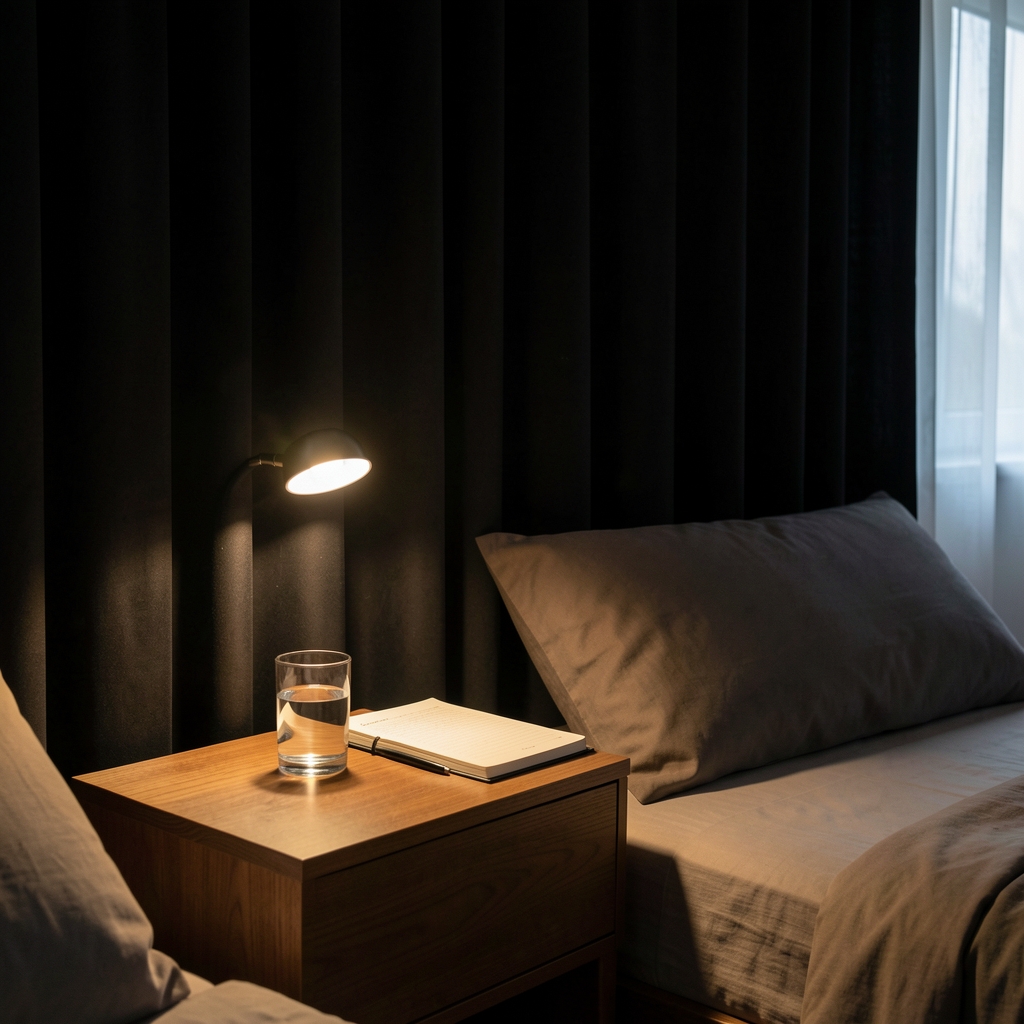
The practical response is to reduce light intensity and shift toward warmer-spectrum light sources in the two to three hours before the intended sleep time. Many people find that the consistent use of screen-free periods in the final hour before sleep — reading a physical book, a brief walk, or simply sitting in a dimly lit room — supports the transition toward sleepiness more reliably than any single supplement or device.
Screen applications that shift the display toward warmer tones in the evening can reduce but do not eliminate the circadian signal sent by artificial light. They are a partial response to a problem that is, in part, an architectural one: many modern living environments are lit brightly and in a blue-spectrum register throughout the evening, which is at odds with the conditions under which the body's timing system operates most predictably.
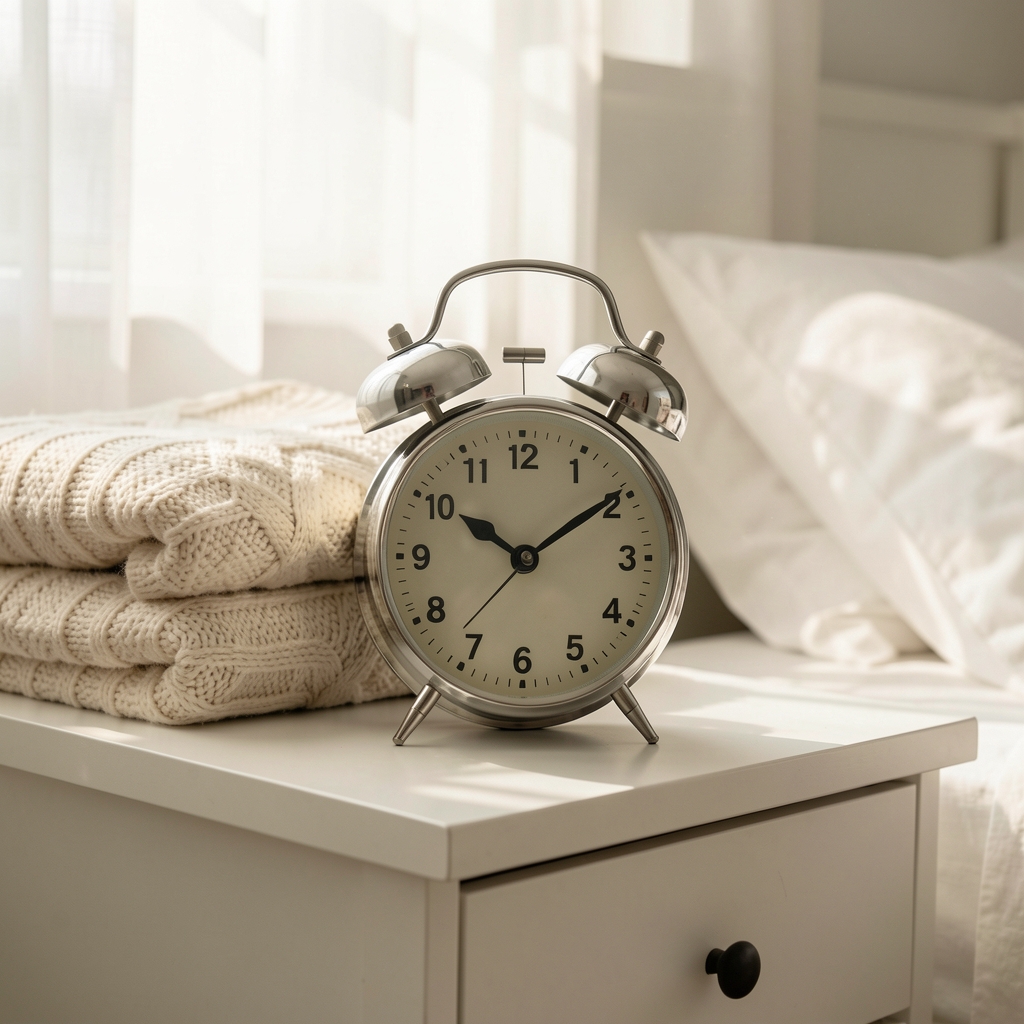
Among all the practical recommendations in the sleep-quality literature, consistent wake time appears most frequently. It appears more often than consistent bedtime, more often than any particular evening routine, and more often than specific environmental modifications. The reason is straightforward: waking at a consistent time provides the most reliable anchor for the entire circadian cycle.
Bedtime varies naturally. Some evenings bring earlier sleepiness; others involve social activities, work demands, or simply the difficulty of disengaging from the day. Wake time is more controllable. A person who wakes at 6:30 consistently — even after a late or disrupted night — will, over time, develop a more stable pattern of evening sleepiness than someone whose wake time shifts by two or three hours depending on the previous night.
This does not mean that sleep debt should be ignored. A person who has had significantly less rest than usual will benefit from an earlier bedtime the following evening or, in some circumstances, a brief nap. The key insight from the circadian literature is that consistency on the waking side of the cycle has outsized influence on the stability of the timing system as a whole.
The sleep literature increasingly notes sex-related differences in circadian timing. Research in chronobiology has documented a modest but consistent difference in the average circadian phase between men and women, with men tending toward a slightly later phase — that is, later natural sleepiness and later natural waking. This tendency is most pronounced in young adulthood and narrows with age.
For men whose work or family schedules require earlier wake times than their natural phase would suggest, this can result in a sustained mild misalignment — one that manifests as difficulty falling asleep at an earlier time, difficulty waking at the required time, and a general sense that the sleep-wake schedule is being imposed on rather than aligned with the body's own timing. Addressing this through consistent early morning light exposure, reducing evening light earlier, and anchoring a consistent wake time are the most reliably documented approaches.
The night routine, in this context, is not a fixed set of activities but a set of conditions that signal to the circadian timing system that the active phase is ending. Consistency, dimness, and a reduction in stimulating activities are more important than the specific content of any particular routine.
Napping is not straightforwardly beneficial or harmful within the circadian framework; it depends on the timing, duration, and the baseline sleep context. A nap taken in the early afternoon — between roughly 13:00 and 15:00, a period that corresponds to a natural secondary dip in alertness observed in many circadian studies — and limited to twenty to thirty minutes is unlikely to disrupt evening sleep for most people and may provide a modest restoration of alertness and cognitive function.
Naps taken later in the afternoon or early evening, or extending beyond forty-five minutes into full sleep cycles, are more likely to reduce the pressure for evening sleep and delay the natural onset of sleepiness. For people who already find it difficult to fall asleep at their intended bedtime, afternoon napping often compounds the problem.
The useful frame for nap strategy is not "is napping good or bad" but "what does my circadian timing system need right now, and does a nap at this moment support or disrupt that?" This requires some familiarity with one's own patterns — which is, ultimately, what a sleep tracking journal is for.

Tobias writes about circadian biology, light exposure, and the practical conditions of the modern sleep environment. His background is in lifestyle journalism, with a focus on how evidence-informed research translates into everyday observable habits.
More from the current issue →